
Adrift
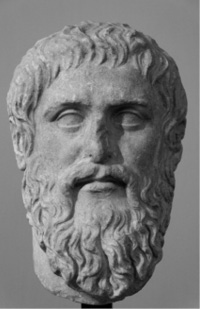
Plato
Did the wind die? Without a wind can there be a second wind? There are frequent “breaking wind” events, I’m confident.
Josef Pieper in “Leisure the Basis of Culture” is short, clear, and to the point. I have a lot of leisure. Where is my culture? I have no excuse; I have the time.
I am reading Socratic dialogs with satisfaction. I cannot speak of all the extensive dialogs written by Plato that I have not read, but I can speak about what I have read and browsed. They include at this point the Apology, Crito, Phaedra, Pheadrus, Parmenides, Euthyphro, and a few more. Reading them is currently like a new ballgame for me.
I have recently developed a respect for Plato after all these years of being intimated by him and not attracted to him and his “realistic” philosophy. The dialogs, though often long, are entertaining. I can imagine the delight of Greeks who read these stories when scrolls of these stories reached them. How did it reach them? How many copies were made?
Plato’s literary production is greater than the Bible and he wrote it all himself. I would like to know more about the publication and distribution of these stories. Any clues will be appreciated.
Aren’t they comics? These dialogs. Or forerunners of comics? Although they are without illustrations.
Plato’s productivity is more impressive than his philosophy for me at this point. The hard work and time required to write so much make a sluggard like me marvel. His production compares somewhat with Howard Garis’s Uncle Wiggly stories. Garis wrote a story each day, six days a week, for the Norfolk Evening News from 1910 to 1947 — a total of more than 11,000 stories. That’s tough to match. Garis also wrote the Rocket Riders Series among a host of other children’s books that I have not seen or read.
Plato sets up each dialog cleverly. For example, we have the Theaetetus. We are told it is written by Eclides, from what Socrates had told him about the conversation that included Theaetetus, the promising young man; Theodoros (an elder retired teacher of geometry and mathematics); and Socrates himself.
They are strolling along, perhaps in the Agora. Socrates asks Theodoros (the math teacher) if he knew of any promising young people. Theodoros says,
Yes, Socrates, I have met with a youth of this city who certainly deserves mention, and you will find it worthwhile to hear me describe him [I’m chuckling already]. If he were handsome, I should be afraid to use strong terms, lest I should be suspected of being in love with him. However, he is not handsome, but – forgive my saying so – he resembles you in being snub-nosed and having prominent eyes, though these features are less marked in him. [Don’t chuckle.]
Thus, we get a picture of Socrates. Not a beauty candidate. He does not take offense. He jokes with Theaetetus about it when meeting him shortly after.
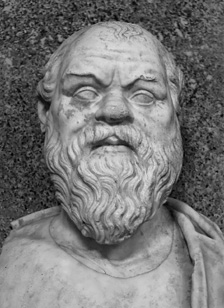
Socrates
Theodoros: . . . Theaetetus, come this way and sit by Socrates.
Socrates: yes, do, Theaetetus, so that I may study the character of my own countenance, for Theodoros tells me it is like yours.
Plato must have had fun with this, and he gives the reader a playful start to the dialog. Aren’t the dialogs like a radio show? Each dialog is begun in some inventive way. In the Phaedo, friends are gathered with Socrates engaged in dialogs on the last day of his life. Socrates has refused pressure from his friends to escape. He drinks the hemlock that evening. Among other issues discussed during the day, Socrates articulates his doctrine of the everlasting soul, and the obstacle to knowledge that the body presents.
This question is asked as the report of the conversation — the dialog — gets under way.
Echecrates: Who were actually there?
Phaedo: [Phaedo names the attendees and ends the list with the remark] I believe that Plato was ill.
Huh? Makes me chuckle.
That is intriguing. Are we to take it literally? How did creating and circulating these stories work? Presumably the dialogs were written on papyrus. On scrolls. Did scribes make copies? Were they sent as letters? I’m looking around for answers and clarity. I read that Plato was called Plato because he is so broad. He was a champion wrestler as well literary genius. For sure he was broad.
Fueled by the condition of my body as an 88-year-old person, I have read Socrates’ rejection of the human body in the Phaedo. In it he praises death to free his soul for top-notch philosophy. Bodies are in the way of pure thought. Our bodies are obstructions to trustworthy thought. In fact, bodies are blemishes to the soul.
Socrates will die today. At sunset. He is eager to die. Meanwhile he delights in conversation with friends. I intend to explore Socrates’ conversation with his friends in which he engages in convincing them of the great freedom that is in store for him as serious philosophy reveals and he asserts. This is the day of his execution scheduled for sunset. Should it need justification for us to pursue this and check out Socrates (or Plato’s convictions) we can note the foundation for Christian beliefs in the eternal soul.
I look forward to conversation. Read ahead for fun “The Phaedo.”