
Please pass the bread
I consider myself blessed that I was encouraged to cook alongside my mother and grandmothers when I was a child. They allowed me to stir a pot or roll a slab of dough, which I thought was great fun. Particularly in my grandmothers’ kitchens, I sensed a magical aura that made my heart beat faster. My father’s mother, who spoke English with a deep Danish accent, produced enormous platters of meats and perfectly cooked vegetables that matched her abundant number of guests on Sunday afternoons. She didn’t do anything in a small way. Three meats and browned potatoes were standard, plus homemade rolls, as well as many vegetables and separately plated salads followed by gorgeous desserts. Her generosity resulted in food comas that left us kids barely able to drag ourselves from the table to the sofa to read the “Funnies.”
My Swedish grandmother, on the other hand, preferred smaller parties; usually no more than eight guests, but also with delicious offerings of succulent pot roasts accompanied by tasty vegetables and strawberry shortcake for dessert. But food aside, what I liked best about both grandparents’ homes, was feeling welcomed into the kitchen to help out however I was able, even from the time I was very little. I believe my love of cooking and baking began with my grandmothers and my parents who let me cook and allowed me to make mistakes.
Those days of donning grandmothers’ aprons and learning to braid cardamom loaves inspired me to let our three children get their hands into dough and other ingredients early on. It was, of course, much easier to cook by myself, but when time allowed, we cooked and baked together. On balmy days I’d haul my KitchenAid mixer outside to a little table on our back deck where we’d mix up rye bread or cookie dough, adding ingredients with the motions and sounds of dump trucks.
And now (how can it be?)…suddenly I’m the Mormor, with a keen desire to teach another generation about the value of making good food and joining with others at the table. With the birth of our first grandchild, my husband and I made the drastic move from Lund, Sweden, to the Upper Peninsula of Michigan, to help care for baby Amos. Unknowingly, he is teaching us to consider, even more than we did with our own children, the importance of what we believe about faith, food and welcoming people to eat with us.
Just as playing quality music in the background increases a child’s love and appreciation for good music, cooking and eating together enhances a child’s relationship with food and the goodness of enjoying it in community. Food traditions are important to every people group, and I believe that cooking together is the greatest, most tangible way to pass on our heritage, cooking skills, appreciation for food and a desire to serve others.
I recollect how baking bread or scrambling eggs with our kids was at times an inconvenient disaster, but now they are all proficient cooks and bakers with far wider repertoires than their parents. Our son and his Chinese-American wife fill their plates with fabulous dumplings and tasty Chinese noodles and sauces, that until meeting Olivia I had never heard of. Our other son throws parties where he creates delicious pizzas in an outdoor beehive oven for 40 people at a time. And Amos’ parents bless him with their homemade maple syrup, apple sauce and cider, foraged morels, mushrooms and berries; plus fresh vegetables from their garden and the spoils of hunting and fishing right where they live. Not only will Amos see where much of his food comes from, he will learn how to gather it, prepare it, and how to share it.
So today, a great gift to me, is time with this curious little guy who already delights in watching me stir up a bowl of bread dough. He likes to touch it and smell it. This heady bread dough, which sits in the refrigerator gaining flavor and strength for up to two weeks is our answer to living in a place with few bakeries — an enormous contrast to Lund. It’s also our way of sharing our food heritage with Amos. I trust he will learn the importance of creating tasty, nutritious food and the paramount privilege of welcoming others to the table to enjoy it.
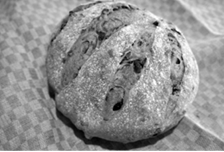
Cranberry Pecan Peasant Bread
3 cups lukewarm water
1 ½ T. active dry yeast (11g)
1 ½ T. Kosher salt (18g)
½ cup rye flour (60g)
½ cup whole wheat flour (70g)
5 1/3 cups unbleached all-purpose flour (670g)
1 cup dried cranberries (115g)
1 cup orange juice or water to plump cranberries
1 ½ cups rough chopped pecans (150g), toasted in 350°F oven for 6-7 minutes.
Place cranberries in orange juice or water. Soak for 20-30 minutes.
Drain off liquid.
Dissolve yeast in water in a 5 qt. bowl.
Whisk flours and salt together in a separate bowl. Add to the water and yeast.
Stir mixture together using a Danish dough hook or wooden spoon. When it becomes difficult to stir, switch to a plastic bowl scraper and clean off sides of bowl as you continue mixing. Add pecans and cranberries turning dough over on itself, rotating the bowl until the dough is evenly uniform. Do not over-mix or knead the dough.
Cover bowl, but do not make it airtight. Allow the dough to sit at room temperature for about two hours while it rises and falls.
You may bake a loaf of bread at this point, but the dough will gain flavor and become easier to handle if it rests in the refrigerator for at least 24 hours.
Also, it may remain refrigerated for up to two weeks, gaining deeper flavor with each passing day.
Shaping and Baking the Bread
Sprinkle a small amount of corn meal on a pizza peel or baking sheet that has no edges. Set a piece of baking parchment on top of the peel and give it a light coating of corn meal. Now you have a thin layer of corn meal above and below the parchment.
Take dough from the refrigerator and lightly sprinkle its surface with flour. With a wet serrated knife and generously floured hands, cut and lift a quarter of the dough from the bowl. Swiftly shape the dough into a ball, stretching and smoothing the outside surface while rotating the dough by quarter turns as you tuck wrinkles under the bottom. Dip your hands into flour a few times during this process which should take no more than a minute. Set the rounded dough onto the baking parchment.
Allow dough to rest and rise in warmish room temperature for an hour. Half way through the rise, place baking stone on the middle rack of the oven and set the temperature to 450°F.
Sprinkle risen loaf with flour and slash the surface several times with a serrated knife or bread lame. Swiftly slide risen loaf from peel to hot baking stone in the oven, keeping the parchment under it. Bake for 35-40 minutes or until the crust is deep golden brown. You may need to rotate the bread near the end of baking for even browning.
Allow bread to cool completely before slicing.
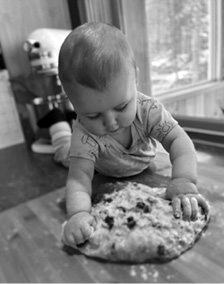
Amos with his helping hands in the dough. (Photo: Bonnie Sparrman)
Cook’s Note:
This dough is best handled with the help of a simple plastic bowl scraper with a rounded edge. It’s especially useful when adding the pecans and cranberries. Also, you may omit the cranberries and nuts if you like a plainer bread for sandwiches or toasting.
This recipe is inspired by “Artisan Bread in Five Minutes a Day” by Zoë François and Jeff Hertzberg.