
USAID and the Covenant church’s mission
As I eased into retirement, I chose to occupy my time with, among other activities, volunteering, working part-time, being a tourist, visiting “shut-ins,” and crafting special projects. Regarding the latter, I initially planned to immerse myself in archival boxes in the basement of Brandel Library on the campus of North Park University to focus on the Covenant denomination’s mission field in Congo, particularly the period surrounding the 1960 assassination of the democratically-elected Congolese President, Patrice Lumumba, as well as the 1964 murder of Covenant medical missionary, Paul Carlson. I had known that Carlson had been shot and killed after he followed God’s calling, and my eyes watered as I sat in the Covenant’s archives and actually held his New Testament with shrapnel holes.

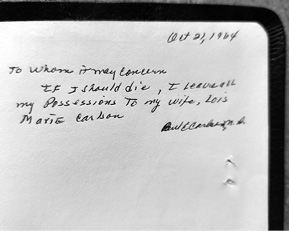
Bullet hole in Paul Carlson’s Bible. Inscription on the inside cover of Paul Carlson’s Bible.
I visited the archives dozens of times and spent numerous hours there. Unexpectedly, I was also drawn to immerse myself in the decades prior to the 1960s. In the 1930s, the Covenant denomination accepted an invitation from the Evangelical Free Church to build a mission partnership in Congo. I reviewed box after box, page by page, and learned about the struggles and achievements in this mission field. For example, I discovered that in 1937 married and single missionaries received a modest annual income of $1,240 and $700, respectively, or the impressive fact that Congolese membership in the Covenant church rose from 8,886 members in 1955 to 10,354 one year later.
Beyond statistics I learned the mission field sought in 1944 to build an orphanage for “untainted children of leprous parents.” Over the years, Congo has been host to debilitating parasitic diseases such as filaria, passed through mosquito bites. One Covenanter wrote in 1955 that, “Liver disease is the nemesis of the tropics and is a primary cause of repatriation among the Belgians in Congo.”
Various correspondence, notes, and memoranda referenced the farming of mango trees, organizing sewing classes, making bricks, identifying water supplies, baptisms, and endeavoring to meet the constant need of money to buy a new truck, unclog pipes of iron deposits, improve inadequate buildings, attract qualified staff, and much more. In considering these varied tasks, the important as well as mundane, I thought of how St. Paul wrote “keep your head in all situations, endure hardship, do the work of an evangelist, discharge all the duties of your ministry” (2 Timothy 4:5).
My rolling exploration into the archival unknown revealed to me that in 1959, which President Dwight D. Eisenhower declared the “Year of the Refugee,” the Executive Director of Covenant World Missions wrote about another budget deficit. An application for funding from the United States’ Agency for International Development (USAID) appeared in this archival trove. I found other references to USAID during my research. For example, in 1962, USAID funded the salary, transportation, and housing of a Covenant medical missionary nurse. One year later, the Covenant entertained the creation of a pre-university training program in Congo with USAID funding, and continued efforts to secure funding for the school. In a letter written in 1970 with the greeting, “Dear Missionary Comrades,” a married couple prepared for mission work in Congo shared, “We go as Covenant missionaries seconded to the Paul Carlson Foundation, under the Foundation’s support. The program of the Foundation is largely funded by grants from other foundations, U.S. AID (indirectly)….” Further, the same Covenant medical missionary wrote that “OXFAM (a British organization) gave us a grant for a corral and 100 cattle. U.S. AID gave us huge culverts to construct a dike so that we can get to the corral in about half the distance it takes us now.”
In 2025 when politicians dramatically cut the USAID budget and placed global personnel on paid administrative leave, pernicious outcomes shortly followed. CNN reported that malnutrition “soared” in Afghanistan to 9.5 million people with over 400 clinics closing due to the cuts. Nicholas Kristof of the New York Times wrote that since the aid cuts kill more Christians than Jihadists do, then “if Trump cares about Christians or anyone else in Nigeria, all he needs to do is restore aid and let babies live.” Though only amounting to about one percent of the total national budget, USAID money has helped stabilize and uplift communities through food and educational programs and health initiatives. The positive effects thus reduce violence or, in other words, as Psalm 34:14 reads, “Seek peace, and pursue it.”
During the 140th Annual Meeting in Orlando, Florida, the Evangelical Covenant Church passed a “Resolution on Humanitarian Aid.” (See the text of the introduction and resolution on the next page.) Though I support the concerns expressed in the resolution, I lament the resolution’s blandness and brevity (especially in contrast to the 2007 Resolution on Human Sexuality, which spans 34 pages plus bibliography). The document “humbly encourages and implores” unnamed “governments” to respond to God’s mandate to care for marginalized people, when clearly one government is being addressed.
I spoke to an attending delegate who explained that a vocal faction at the Annual Meeting believed the resolution was “too liberal.” This sentiment can also lead to what Rev. Jim Wallis addressed during his April 2005 interview with the Covenant Companion wherein he decried how some Christian conservatives have twisted faith as a “‘purely private matter’” countering that the “privatization of God is the greatest heresy of the twentieth century.”
To be kingdom people, I believe we must think and act globally. A vocal faction of evangelical Christians have placed too much emphasis upon certain social mores and political philosophies rather than upon the focus of the Savior and his message of love. In other words, “America First” need not mean “Africa last.”
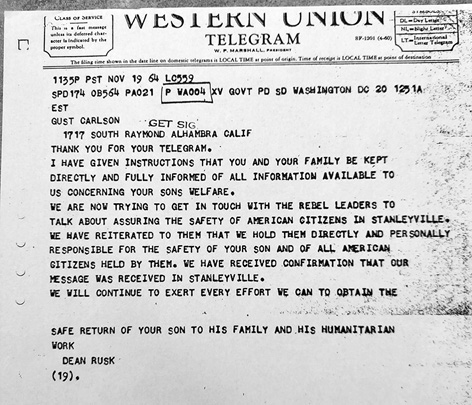
Telegram from Dean Rusk to Paul Carlson’s parents, concerning his kidnapping.
2025 Resolution on Humanitarian Aid
This resolution affirms the essential humanitarian work that many governments provide, acknowledges that work as one way we carry out our Lord’s command to love our neighbor.
USAID has recently experienced severe cuts in funding. A May 5, 2025, article by Oxfam America estimates that as a result of these cuts, “At least 23 million children stand to lose access to education, and as many as 95 million people would lose access to basic healthcare, potentially leading to more than 3 million preventable deaths per year.”
Considering that USAID addresses many of the same issues and concerns addressed by our denomination, global partners, global personnel, and Christians throughout the world, such as hunger, clean water, education, health care, and community development for some of the last and the least in our world;
And considering that some of the regions of the world where these cuts are having the most severe and detrimental effects are the very regions where the Evangelical Covenant Church has been working for many years in partnership with sister churches, congregants, and organizations who will be negatively impacted by these cuts, including places like the Democratic Republic of Congo, South Sudan, Gaza, and India;
And considering that prior to these cuts, funding for USAID amounted to only about 1% of the total US budget; and gratefully acknowledging that prior to these cuts the United States was the largest single contributor to International Development, but when aid is calculated as a percentage of Gross Domestic Product (GDP) or when aid is calculated per capita, the United States (even prior to these cuts) ranked significantly lower than many other developed countries;
RESOLVED: The 140th Annual Meeting of the Evangelical Covenant Church affirms the essential humanitarian work that many governments provide, acknowledges that work as one way we carry out our Lord’s command to love our neighbor, grieves the preventable suffering and loss that will result when such funds are cut, and humbly encourages and implores governments to consider the restoration of the life-saving funding where it has been reduced, and expansion of such funding wherever possible.
https://covchurch.org/resolutions/2025-resolution-on-humanitarian-aid/